Geofences
Two modes are available on the tab: Geofences and Groups. In the Geofences mode, you can create geofences and perform the following actions with them: editing, copying, deleting, creating notifications about crossing geofence borders. You can also show and hide geofences on the map.
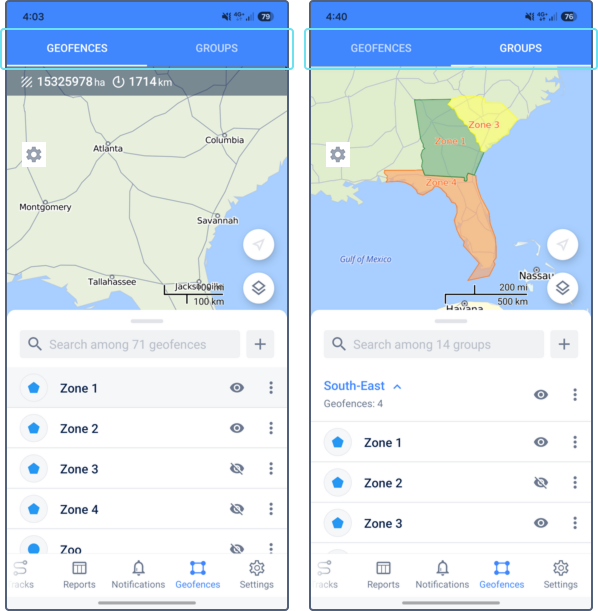
In the upper-left corner of the map, you can see the area and perimeter of the selected geofence. Drag the top border of the list to expand it to full screen.
Creating geofences
In the application, you can create circle and polygon geofences. To create a line geofence, use the web version.
To create a geofence, follow these steps:
-
On the Geofences tab, navigate to the approximate location on the map where you want to create the geofence.
-
Tap the icon
 to the right of the search bar or select Create geofence in the menu that opens after a long tap on the map.
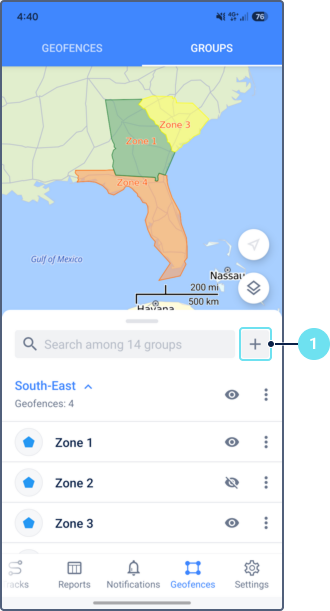
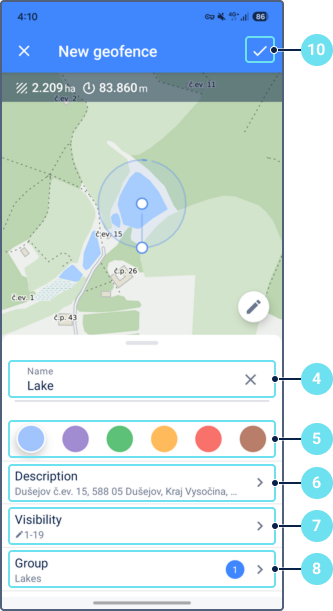
By default, a circle geofence with a radius of 100 m is created in the center of the map. Its area and radius are shown at the top of the screen and are recalculated as you edit the geofence.
-
To change the shape, the size, or the location of the geofence, tap the icon
 or tap the geofence on the map.
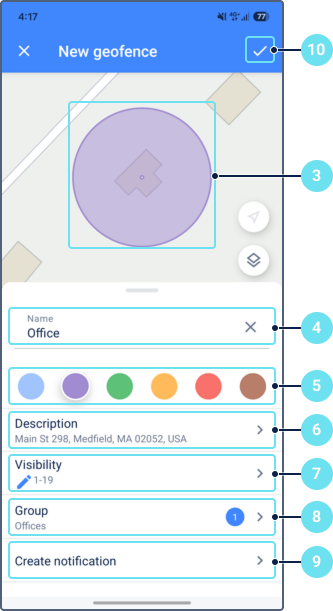
See Selecting the geofence shape, Editing circle geofences, and Editing polygon geofences. When the geofence has the required shape, size, and location, tap the icon
 on the toolbar to return to the geofence properties.
-
Edit the geofence name if required. By default, the geofence name is the address of its central point. If the address isn’t available, coordinates are used instead.
-
Select the color.
-
If necessary, specify the description. By default, the address of the central point of the geofence is specified.
-
Specify the visibility value of the geofence (from 1 to 19). See Geofence properties.
-
If necessary, select the group to which the geofence should belong.
-
If necessary, tap Create notification to set up a notification for this geofence. See Creating notifications for geofences.
-
Save the changes.
To exit without saving, tap the icon  and confirm the action by tapping Discard. To return to editing, tap Keep editing.
Selecting the geofence shape
Use the shape selector on the map to switch between the circle and the polygon. The selected shape is highlighted in blue.
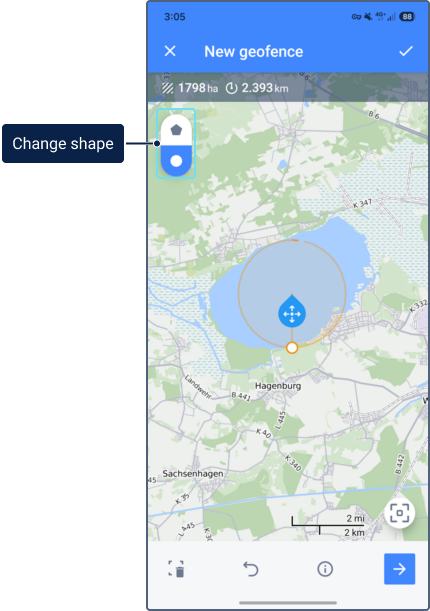
If you have already changed the geofence on the map, the system asks you to confirm the action: tap Change shape to switch the shape and delete the current result, or Keep editing to stay with the current shape.
The result created with the previous shape can’t be restored.
Editing circle geofences
To change the position of the geofence, tap the point in its center, then long-tap the icon  and drag the geofence to the required place.
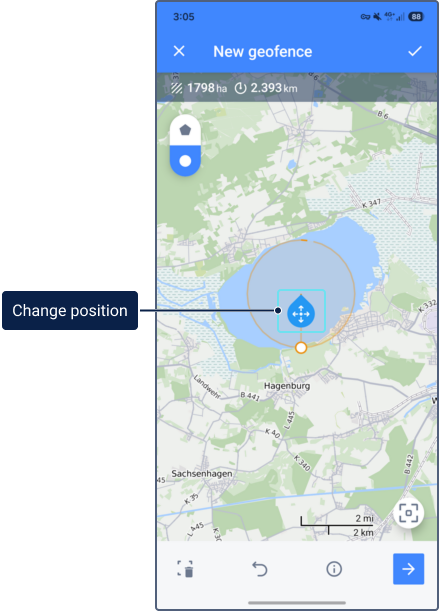
To change the radius, tap the point on the border of the geofence and drag the icon in the same way.
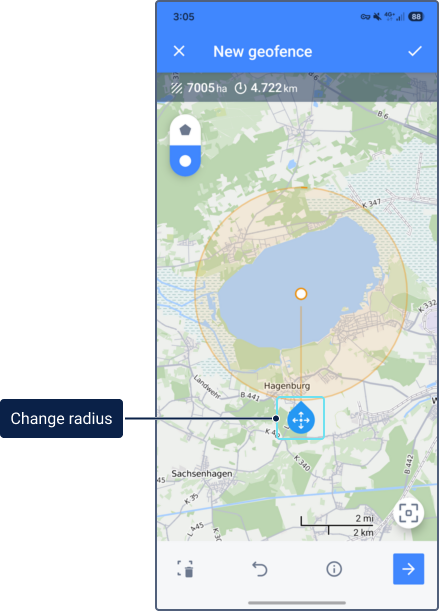
Editing polygon geofences
To create a polygon, tap the map to add points. A polygon requires at least 3 points and can contain up to 50. When the limit is reached, you can’t add new points.
The points are connected with lines, and a secondary point is added in the middle of each line. The area and perimeter of the geofence are shown at the top of the screen and are recalculated after each change.
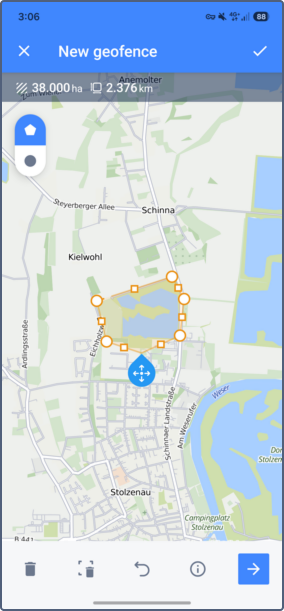
To edit the polygon, use the following actions:
- Move a point: tap the point, then long-tap the icon and drag it to a new location.
- Add a point: tap a secondary point in the middle of a line. It becomes a main point, and two new secondary points are added next to it.
You can’t edit the shape of a polygon that contains more than 50 points. Such geofences can be edited only in the web version.
Toolbar
The toolbar is located at the bottom of the screen.
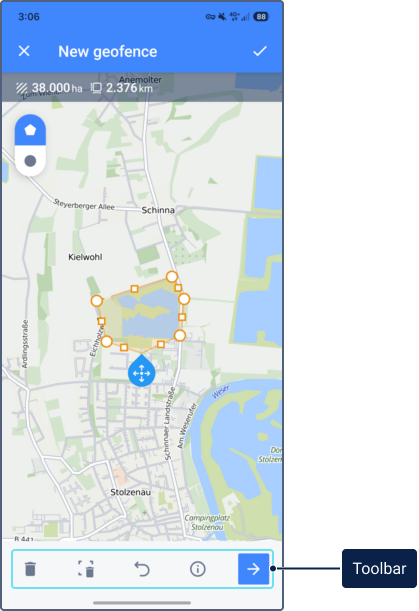
The toolbar provides the following actions:
| Icon | Action | Description |
|---|---|---|
 |
Delete point | Delete the selected point. The shape and the measurements are updated. |
 |
Start over | Delete the whole geofence from the map and start creating again. |
 |
Undo | Undo the last action while keeping other changes. Up to 100 actions are available. |
 |
Info | Show the in-app help on creating geofences. |
|
Next | Apply the shape and return to the screen with the geofence properties. The action becomes available when the polygon has at least 3 points and forms a closed area. |
The actions are available only when they can be applied. For example, you can delete a point only after you select it on the map.
Managing geofences
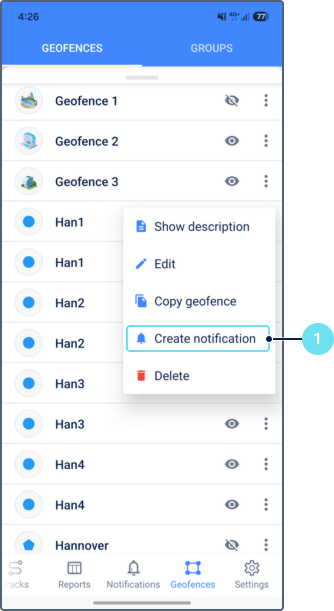
A tap on the icon  or a long tap on the geofence in the list opens its menu. Depending on the access rights and the shape of the geofence, the menu can contain the following actions:
| Icon | Action | Description |
|---|---|---|
 |
Show description | Show or edit the geofence description. To edit the description, tap the icon  in the upper-right corner. |
|
Edit | Edit the geofence properties. The set of editable properties depends on the shape of the geofence and the access rights of the user. For all geofences, you can edit the name, color, description, visibility, and group. Besides, you can edit the description using the Show description action. For circles and polygons, you can also change the shape of the geofence on the map. See Editing circle geofences and Editing polygon geofences. You can’t change the shape of lines and of polygons that contain more than 50 points. |
 |
Copy geofence | Copy the geofence. Available only for circle-shaped geofences. When performing this action, color, description, and size are copied. As well as when creating a geofence, you can change its size, select the location and specify the properties. |
 |
Create notification | Create a notification template of the Geofence type. See the details below. |
 |
Delete | Delete the geofence. |
Showing and hiding geofences
To show or hide a geofence on the map, tap the icon  next to its name in the list.
To show a geofence, you can also select (tap) it in the list. When a geofence is selected, it is displayed in the center of the map.
To show or hide all geofences at once, use the Geofences option in the settings.
Creating notifications for geofences
To create a notification for a geofence, follow the steps below.
- Select the Create notification action in the menu of the geofence.
- Type in the notification name.
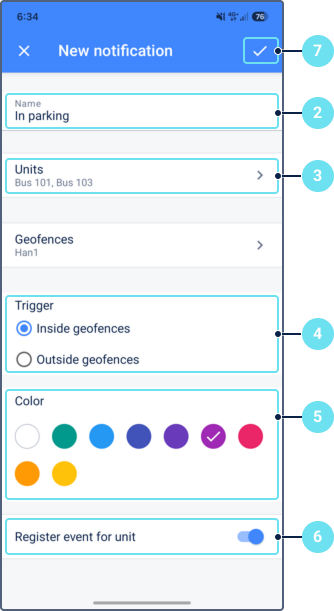
- Select the unit or unit group for which you want to create a notification.
- Specify the trigger condition: when the unit is inside the geofence or outside it.
- If you want to visually distinguish this notification from others, select a color in the Color section. A colored indicator is displayed on the left edge of notification cards on the History tab and in the notification detail view.
- If necessary, activate the Register event for unit option. The option allows you to register the triggered notifications as events that can be available on the History tab of the unit and or in reports.
- Save the notification.
You can also create notifications for geofences in the properties on the Notifications tab.